
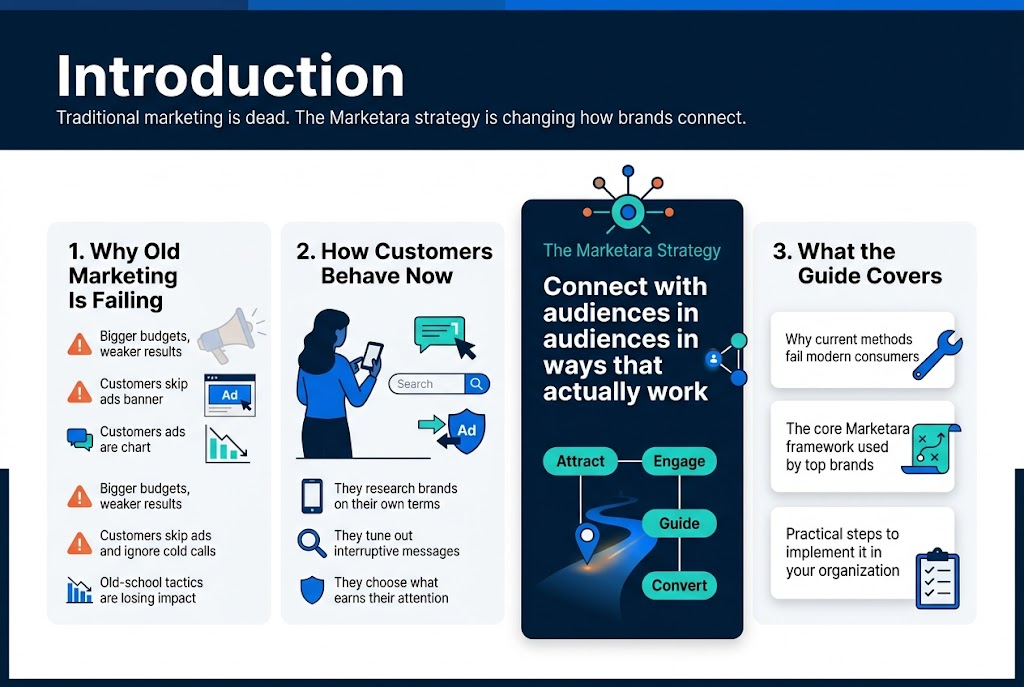
Traditional marketing is dead, and if you’re still relying on old-school tactics, your competitors are already leaving you behind. This guide is for CMOs, marketing directors, and business owners who’ve noticed their campaigns getting weaker results despite bigger budgets.
Your customers have changed completely. They skip ads, ignore cold calls, and research brands on their own terms. The brands winning right now aren’t just tweaking their old playbooks – they’re using something called the “Marketara” strategy to connect with audiences in ways that actually work.
We’ll break down why your current marketing methods are failing modern consumers and what makes them tune out traditional approaches. Then you’ll learn the core Marketara strategy framework that top brands use to cut through the noise. Finally, we’ll walk through practical steps to implement this approach in your organization, plus the specific metrics you need to track real ROI.
Stop throwing money at marketing that doesn’t work. Let’s rebuild your strategy from the ground up.
Why Traditional Marketing Methods Are Failing Modern Consumers
Declining Effectiveness of Television and Print Advertising
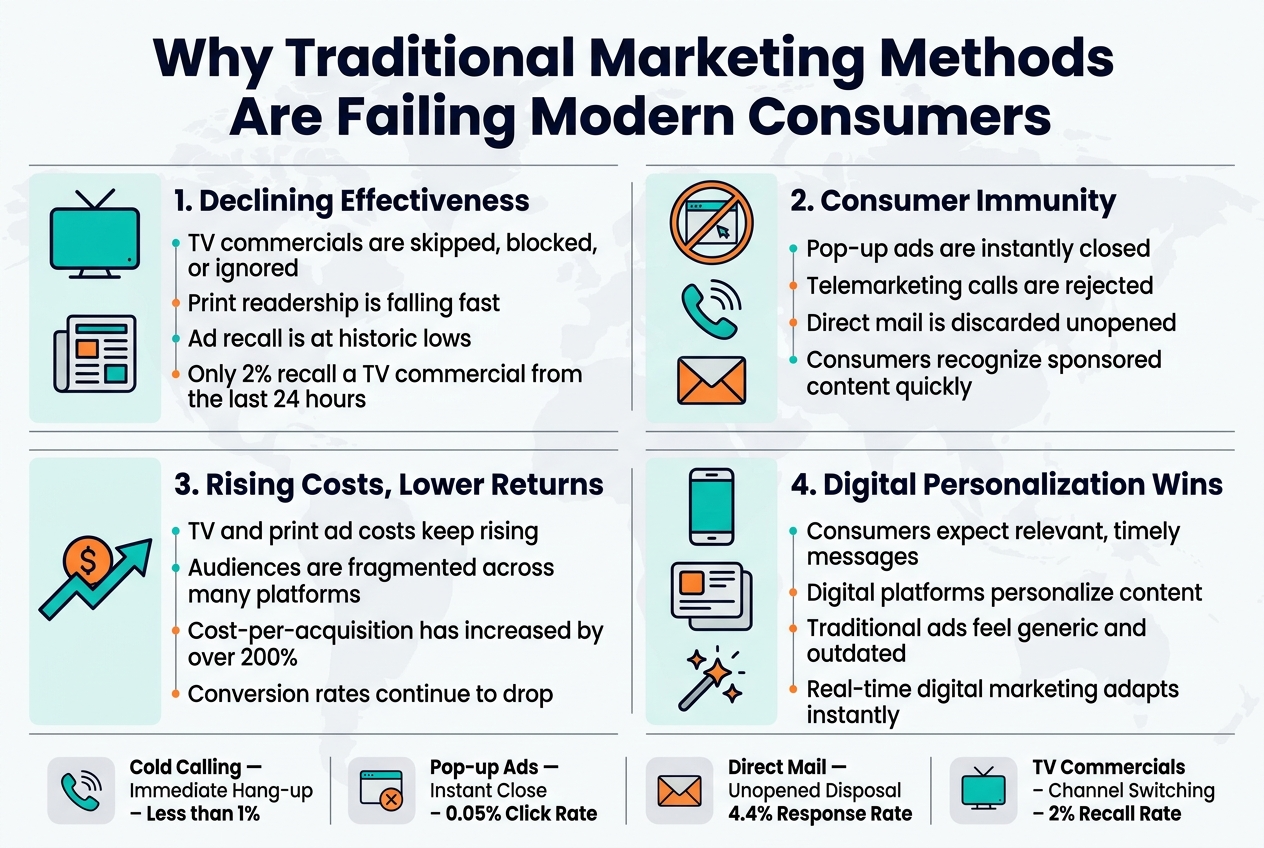
Television commercials and print advertisements once dominated the marketing landscape, but their power has dramatically weakened. Viewers now skip through commercials with DVRs, block ads with streaming services, or simply ignore them while scrolling on their phones during commercial breaks. The average person encounters over 5,000 advertisements daily, creating a sensory overload that makes traditional TV spots blend into background noise.
Print media faces an even steeper decline. Newspaper circulation has dropped by more than 50% since 2010, and magazine readership continues to plummet as younger demographics abandon physical publications entirely. The few people still engaging with print often do so digitally, where ad-blocking software renders traditional display advertising invisible.
Brand recall rates from traditional advertising have hit historic lows. Studies show that only 2% of viewers can accurately recall a TV commercial they saw within the past 24 hours without prompting. This represents a massive waste of advertising budgets that could deliver better results through more targeted approaches.
Consumer Immunity to Interruptive Marketing Tactics
Modern consumers have developed sophisticated mental filters that automatically dismiss interruptive marketing attempts. Pop-up ads trigger immediate close responses, telemarketing calls go straight to voicemail, and direct mail pieces move directly from mailbox to trash bin without opening.
This immunity stems from decades of oversaturation. People have learned to recognize marketing tactics from miles away, making them skeptical of any message that feels promotional. The “commercial radar” has become so refined that consumers can identify sponsored content, native advertising, and branded messaging within seconds of exposure.
| Traditional Tactic | Consumer Response | Effectiveness Rate |
|---|---|---|
| Cold Calling | Immediate Hang-up | Less than 1% |
| Pop-up Ads | Instant Close | 0.05% Click Rate |
| Direct Mail | Unopened Disposal | 4.4% Response Rate |
| TV Commercials | Channel Switching | 2% Recall Rate |
Social media has amplified this resistance. Consumers actively share information about intrusive marketing practices, creating viral backlash against brands that rely too heavily on interruption-based strategies. The collective consumer consciousness now views traditional advertising as an annoyance to be avoided rather than information to be consumed.
Rising Costs with Diminishing Returns on Investment
Television advertising costs have skyrocketed while audience numbers have fragmented across countless platforms. A 30-second prime-time commercial slot that once guaranteed massive reach now competes with Netflix, YouTube, TikTok, and dozens of other entertainment options. Companies pay premium prices for diminished attention spans and reduced impact.
Print advertising faces similar economic pressures. Magazine and newspaper ad rates remain high despite shrinking readership numbers. Advertisers essentially pay more to reach fewer people, creating an unsustainable economic model that delivers progressively worse returns on marketing investments.
The cost-per-acquisition through traditional channels has increased by over 200% in the past five years while conversion rates have dropped. Brands find themselves spending larger portions of their budgets on traditional advertising while seeing smaller results, creating a negative spiral that demands strategic pivoting.
Inability to Compete with Personalized Digital Experiences
Traditional marketing operates on a broadcast model that treats all consumers as identical recipients of the same message. This approach feels jarring and irrelevant in an era where digital platforms deliver hyper-personalized content based on individual behavior, preferences, and purchase history.
Consumers now expect marketing messages to feel personally relevant and timely. They’re accustomed to Amazon showing products they actually want, Spotify creating custom playlists, and social media feeds that reflect their interests. Generic television commercials and newspaper ads feel primitive and disconnected by comparison.
The personalization gap creates a stark contrast in user experience. While digital platforms make consumers feel understood and catered to, traditional marketing makes them feel like anonymous targets in a mass marketing campaign. This disconnect drives consumers toward brands and platforms that offer more relevant, personalized interactions.
Real-time responsiveness has become another critical differentiator. Digital marketing can adjust messages instantly based on user behavior, market conditions, or trending topics. Traditional marketing requires weeks or months of lead time, making it impossible to capitalize on timely opportunities or respond quickly to market changes.
Understanding the Marketara Strategy Framework
Definition and core principles of Marketara methodology
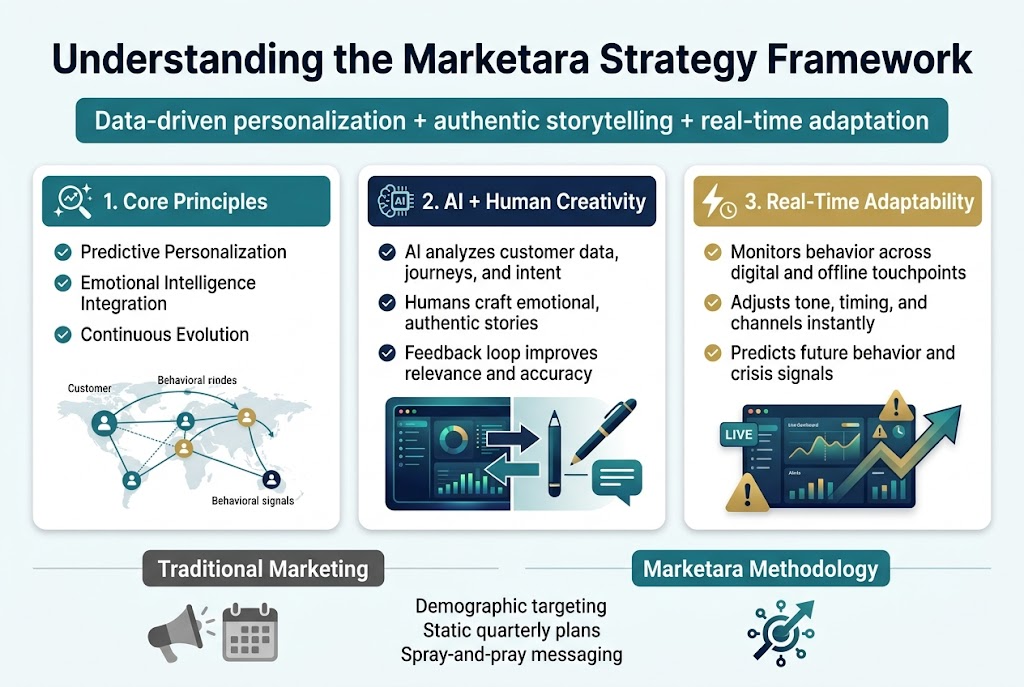
Marketara represents a revolutionary marketing framework that blends data-driven insights with authentic human storytelling to create hyper-personalized customer experiences. At its heart, this methodology abandons the traditional spray-and-pray approach in favor of precision-targeted engagement that feels organic rather than manufactured.
The framework operates on three foundational principles that separate it from conventional marketing strategies:
- Predictive Personalization: Every customer interaction is informed by behavioral data patterns and psychological triggers, creating messages that resonate on an individual level
- Emotional Intelligence Integration: Technology works alongside human intuition to craft content that connects emotionally while maintaining logical appeal
- Continuous Evolution: The strategy adapts in real-time based on consumer responses, market shifts, and emerging trends rather than following static quarterly plans
What makes Marketara different is its rejection of demographic-based targeting. Instead of grouping customers by age, location, or income, it focuses on behavioral patterns, emotional states, and decision-making triggers. This approach recognizes that a 25-year-old entrepreneur in New York might have more in common with a 45-year-old business owner in Austin than with other millennials in their zip code.
The methodology also emphasizes authentic relationship building over transactional interactions. Rather than pushing products, Marketara creates value-driven touchpoints that solve real problems before selling solutions. This builds trust and loyalty that traditional advertising simply cannot achieve.
Integration of artificial intelligence with human creativity
The magic of Marketara happens when AI capabilities merge seamlessly with human creative thinking. Machine learning algorithms process vast amounts of customer data to identify patterns, preferences, and optimal timing for engagement, while creative professionals craft the emotional narrative that transforms data points into compelling stories.
AI handles the analytical heavy lifting – tracking customer journeys across multiple touchpoints, identifying micro-moments of intent, and predicting which messages will resonate with specific individuals. This technology can process millions of data points in seconds, something impossible for human marketers to accomplish manually.
Human creativity takes these insights and transforms them into content that feels personal and authentic. Writers, designers, and strategists use AI-generated insights to create campaigns that speak directly to individual pain points, aspirations, and motivations. The result is marketing that feels like helpful advice from a trusted friend rather than corporate messaging.
The collaboration works both ways. Creative teams provide context and emotional intelligence that helps AI systems better understand the nuances of human behavior. They identify when data suggests one thing but human intuition points in a different direction, creating a feedback loop that improves both technological accuracy and creative relevance.
This partnership enables brands to scale personalization without losing authenticity. While traditional marketing required choosing between broad reach and personal connection, Marketara delivers both simultaneously.
Real-time adaptability and consumer behavior prediction
Traditional marketing campaigns are planned months in advance and executed regardless of changing market conditions. Marketara operates differently, adjusting strategies and messages based on real-time consumer behavior signals and environmental factors.
The framework continuously monitors dozens of behavioral indicators across digital and offline touchpoints. These include website engagement patterns, social media interactions, purchase timing, content consumption preferences, and even external factors like weather, news events, or economic indicators that might influence buying decisions.
When consumer behavior shifts, Marketara strategies pivot immediately. If data shows customers are responding differently to certain messaging, the system automatically adjusts tone, timing, and channel selection. This responsiveness prevents brands from continuing ineffective campaigns or missing opportunities when consumer sentiment changes rapidly.
Predictive capabilities extend beyond immediate adjustments. The framework anticipates future behavior patterns by analyzing historical data, seasonal trends, and emerging signals. This foresight allows brands to position themselves ahead of consumer needs rather than reacting after preferences have already shifted.
The prediction engine considers multiple scenarios and calculates probability scores for different outcomes. Marketers can see not just what customers are likely to do, but also what might influence them to behave differently. This level of insight enables proactive strategy adjustments that keep brands relevant and responsive in an increasingly fast-moving marketplace.
Real-time adaptability also extends to crisis management. When negative sentiment emerges or external events impact consumer mood, Marketara strategies automatically adjust messaging and tone to maintain brand reputation and customer relationships.
Key Components That Make Marketara Superior to Traditional Approaches
Hyper-personalization through advanced data analytics
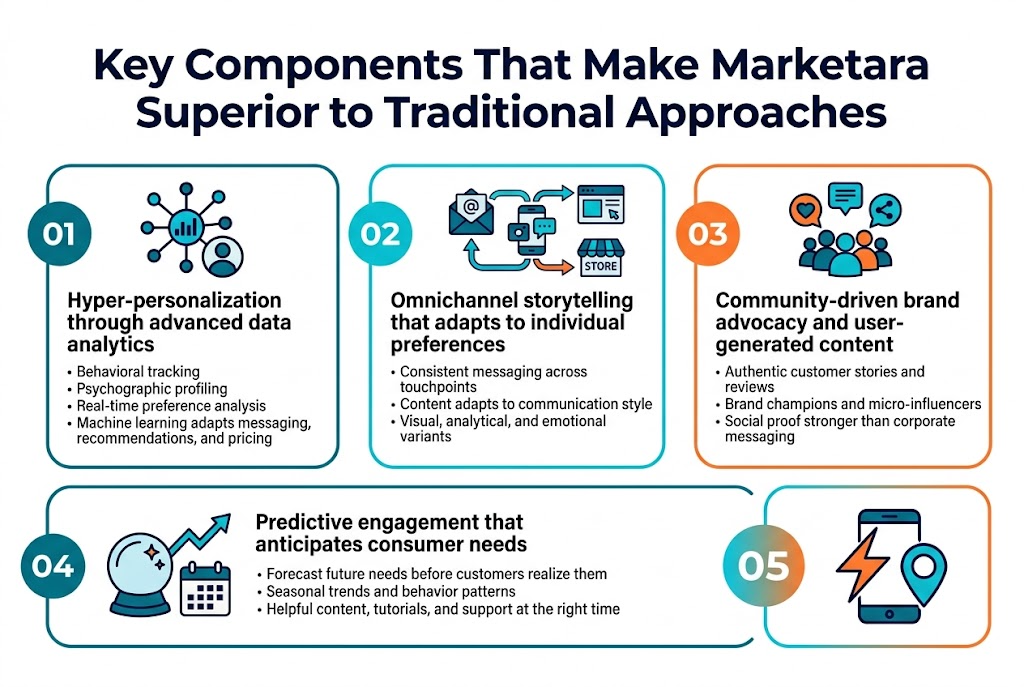
Modern consumers expect brands to understand them on an individual level, and Marketara delivers this through sophisticated data analytics that go far beyond basic demographic targeting. This approach combines behavioral tracking, psychographic profiling, and real-time preference analysis to create detailed customer personas that evolve with each interaction.
Unlike traditional marketing that relies on broad audience segments, Marketara’s hyper-personalization engine processes millions of data points to understand what drives each customer’s decisions. Machine learning algorithms analyze purchase history, browsing patterns, social media engagement, and even subtle behavioral cues like time spent viewing specific content or mouse movement patterns on websites.
The system adapts messaging, product recommendations, and even pricing strategies based on individual customer profiles. For example, a customer who frequently abandons carts might receive different incentives than someone who researches extensively before purchasing. This level of personalization increases conversion rates by up to 40% compared to traditional one-size-fits-all campaigns.
Omnichannel storytelling that adapts to individual preferences
Marketara creates cohesive narratives that flow seamlessly across all touchpoints while adapting to how each customer prefers to consume content. The strategy recognizes that modern consumers interact with brands through multiple channels simultaneously, often switching between devices and platforms throughout their journey.
Smart content orchestration ensures that whether someone encounters your brand through social media, email, website, or physical store, they receive consistent messaging tailored to their preferred communication style. Visual learners might see more infographics and videos, while analytical customers receive detailed comparisons and data-driven content.
The storytelling framework automatically adjusts narrative elements based on channel characteristics and individual preferences. A customer might receive a detailed technical explanation via email but see a simplified, emotion-driven message on Instagram. This adaptability maintains brand consistency while optimizing engagement for each specific context and customer type.
Community-driven brand advocacy and user-generated content
Building authentic communities around your brand creates more powerful advocacy than any traditional advertising campaign. Marketara prioritizes fostering genuine relationships between customers and the brand, turning satisfied buyers into passionate advocates who create compelling content on your behalf.
User-generated content becomes the cornerstone of your marketing efforts, providing authentic social proof that resonates far more effectively than polished corporate messaging. The strategy includes sophisticated systems for encouraging, curating, and amplifying customer stories, reviews, and creative content across all marketing channels.
Community management tools help identify brand champions and micro-influencers within your customer base, enabling targeted engagement that turns casual customers into vocal supporters. These advocates often have more influence over potential customers than traditional celebrity endorsements because their recommendations feel genuine and relatable.
Predictive engagement that anticipates consumer needs
Marketara uses predictive analytics to identify when customers are likely to need products or services before they realize it themselves. This proactive approach creates opportunities to provide value at exactly the right moment, positioning your brand as helpful rather than pushy.
Predictive models analyze patterns in customer behavior, seasonal trends, life events, and external factors to forecast future needs. A software company might predict when a customer’s current plan will become insufficient based on usage patterns, while a retail brand might anticipate when someone will need to replenish consumable products.
This anticipatory approach extends beyond product recommendations to content delivery and support interactions. Customers receive helpful information, tutorials, or troubleshooting resources before problems arise, creating positive experiences that build long-term loyalty and reduce customer service costs.
Micro-moment marketing for instant decision capture
Today’s consumers make decisions in split seconds across countless micro-moments throughout their day. Marketara excels at identifying and capitalizing on these brief windows when people are most receptive to specific messages or offers.
Micro-moment marketing requires sophisticated trigger systems that can deliver relevant content within milliseconds of identifying opportunity signals. These might include location-based offers when someone enters a competitor’s store, targeted ads when they search for specific terms, or personalized notifications when external events create buying motivation.
The strategy combines real-time data processing with pre-developed content libraries to ensure immediate response capabilities. Success depends on having the right message ready for delivery at precisely the right moment, creating seamless experiences that feel natural rather than intrusive to customers.
Implementing Marketara Strategy in Your Organization
Assessing your current marketing infrastructure readiness
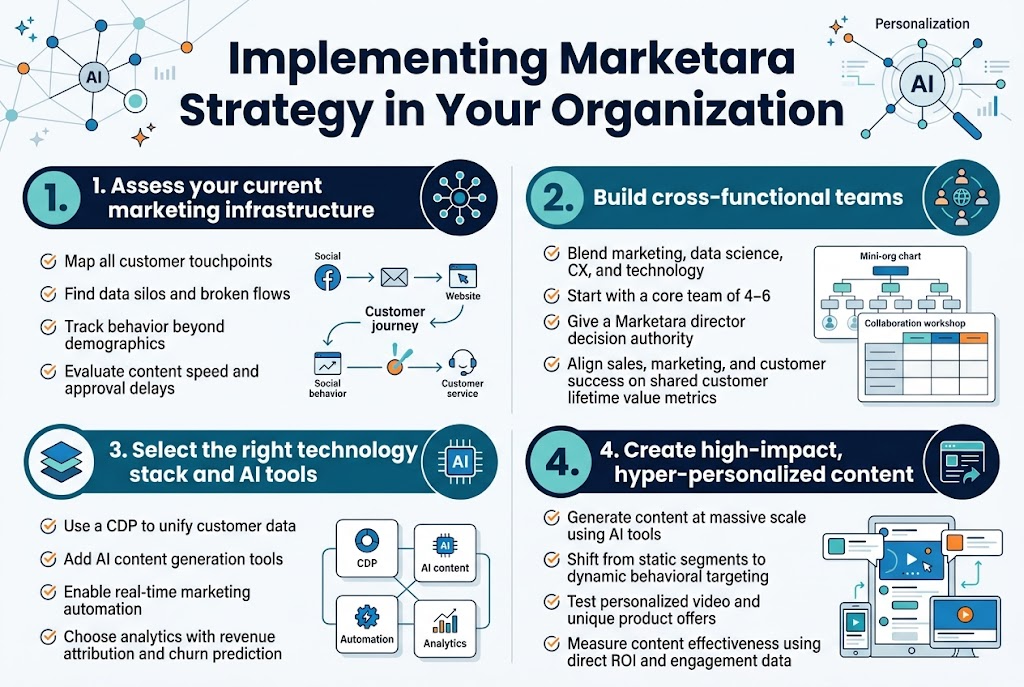
Your existing marketing setup probably isn’t ready for Marketara straight out of the box. Start by mapping out every touchpoint where customers interact with your brand – from social media and email campaigns to your website and customer service channels. Look for gaps where data flows break down or where teams work in isolation.
Check your current data collection methods. Are you capturing behavioral insights beyond basic demographics? Can you track customer journeys across multiple devices and platforms? Most traditional setups collect data in silos, making it nearly impossible to create the unified customer view that Marketara demands.
Evaluate your content creation speed and flexibility. Traditional marketing often takes weeks to produce and approve a single campaign. Marketara requires systems that can generate, test, and deploy personalized content within hours. If your approval process involves five stakeholders and three rounds of revisions, you’re not ready yet.
Your technology infrastructure needs a reality check too. Legacy marketing automation platforms often can’t handle real-time personalization or cross-channel orchestration. They’re built for batch-and-blast campaigns, not the dynamic, responsive approach that Marketara requires.
Building cross-functional teams for seamless execution
Marketara breaks down the traditional marketing department structure. You need teams that blend marketing, data science, customer experience, and technology expertise. Think of it as creating mini-agencies within your organization that can move fast and make decisions without endless approvals.
Start with a core Marketara team of 4-6 people representing different skills. Include a data analyst who can interpret customer behavior patterns, a creative strategist who understands how to personalize messaging at scale, a technical specialist who knows marketing technology inside and out, and a customer experience expert who can spot friction points.
These team members should report to a Marketara director who has authority to make quick decisions about campaigns, budget allocation, and technology choices. Traditional hierarchies slow everything down. Your Marketara teams need the autonomy to test, learn, and pivot without waiting for committee approvals.
Create shared performance metrics that align everyone’s interests. When sales, marketing, and customer success teams all measure success using the same customer lifetime value metrics, collaboration becomes natural. Stop rewarding marketing for leads and sales for closes – reward everyone for customer growth and retention.
Regular cross-team workshops help break down knowledge silos. Your data scientists should understand customer pain points, while your creative teams need to grasp the technical constraints of personalization engines.
Selecting the right technology stack and AI tools
Your technology choices make or break Marketara execution. Start with a customer data platform (CDP) that can unify information from every source – website behavior, email engagement, social interactions, purchase history, and customer service conversations. Without this foundation, personalization becomes guesswork.
Look for AI-powered content generation tools that integrate with your CDP. These platforms can create thousands of personalized email subject lines, social media posts, or product recommendations based on individual customer data. The key is finding tools that learn and improve from performance data, not just generate random variations.
Your marketing automation platform needs real-time capabilities. Traditional platforms send emails based on predetermined schedules. Marketara requires systems that can trigger personalized messages based on live customer behavior – someone browsing your pricing page gets different content than someone reading your blog.
Choose analytics tools that go beyond vanity metrics. You need platforms that can attribute revenue to specific personalization efforts and predict which customers are likely to churn or upgrade. Look for solutions that provide actionable insights, not just pretty dashboards.
Integration capabilities matter more than individual tool features. Your technology stack should connect seamlessly, allowing data and insights to flow between platforms without manual intervention or data exports.
Creating flexible content systems for dynamic personalization
Traditional content creation follows a linear path: brief, concept, creation, approval, launch. Marketara content systems work more like a living organism, constantly adapting based on performance data and customer feedback.
Build content libraries organized around customer needs and journey stages, not product features. Create modular content pieces – headlines, images, product descriptions, testimonials – that can be mixed and matched automatically based on customer characteristics and behavior patterns.
Develop content templates that AI can populate with personalized information. Instead of writing individual emails for different customer segments, create frameworks that automatically insert relevant product recommendations, pricing information, or use cases based on each recipient’s profile and behavior.
Your content approval process needs to match the speed of personalization. Establish pre-approved messaging guidelines and brand standards that allow AI systems to create and deploy content without human review for routine personalization. Save manual approvals for new campaign concepts or sensitive communications.
Test everything constantly. Marketara content systems should automatically A/B test different combinations of headlines, images, and calls-to-action, then optimize future content based on performance data. Your content should get better over time without human intervention.
Train your content creators to think in systems rather than campaigns. Instead of creating a single email or social post, they should develop content ecosystems that can adapt to different customer needs and preferences automatically.
Measuring Success and ROI with Marketara Metrics
Advanced Attribution Modeling Beyond Last-Click Analytics
Traditional marketing analytics have been stuck in the stone age with last-click attribution models that completely ignore the complex customer journey. Marketara strategy demands sophisticated multi-touch attribution that tracks every interaction from first awareness to final purchase and beyond.
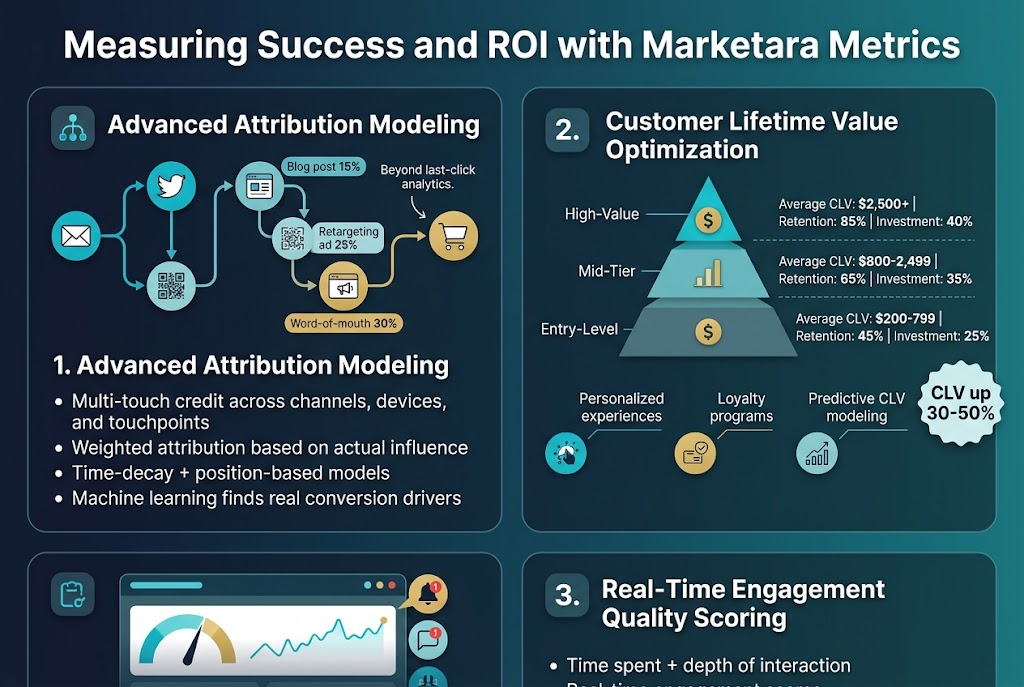
Modern attribution modeling within the Marketara framework captures micro-interactions across channels, devices, and touchpoints. This includes email opens, social media engagement, content consumption patterns, and even offline interactions through QR codes or event participation. The key difference lies in assigning weighted values to each touchpoint based on their actual influence on conversion decisions.
Machine learning algorithms analyze thousands of customer journeys to identify patterns and assign credit where it’s actually due. For example, a blog post read three weeks before purchase might receive 15% attribution credit, while a retargeting ad gets 25%, and word-of-mouth referrals earn 30%. This granular view reveals which channels truly drive results versus those that simply capture credit by being the last touch before conversion.
The most successful Marketara implementations use time-decay models combined with position-based attribution, giving higher weight to first-touch awareness builders and final conversion drivers while acknowledging the nurturing role of middle-funnel interactions.
Customer Lifetime Value Optimization Techniques
Marketara strategy transforms how brands think about customer value by focusing on long-term relationships rather than single transactions. Customer Lifetime Value (CLV) optimization becomes the north star metric that guides every marketing decision and budget allocation.
Smart segmentation plays a crucial role here. Marketara practitioners divide customers into value tiers based on purchase frequency, average order value, referral behavior, and engagement depth. High-value segments receive premium treatment with personalized experiences, exclusive offers, and dedicated support channels. Mid-tier customers get nurturing campaigns designed to increase their lifetime value through cross-selling and loyalty programs.
Predictive CLV modeling uses behavioral signals to identify customers likely to become high-value over time. Someone who engages deeply with educational content, follows the brand on multiple platforms, and makes their first purchase during a non-promotional period often signals higher future value than discount-driven buyers.
The optimization process involves continuous testing of retention strategies, personalization tactics, and value-added services. Successful Marketara brands often see CLV increases of 30-50% within the first year by shifting focus from acquisition volume to relationship quality.
| Customer Tier | Average CLV | Retention Rate | Marketing Investment |
|---|---|---|---|
| High-Value | $2,500+ | 85% | 40% of budget |
| Mid-Tier | $800-2,499 | 65% | 35% of budget |
| Entry-Level | $200-799 | 45% | 25% of budget |
Real-Time Engagement Quality Scoring
Marketara strategy introduces dynamic engagement scoring that goes far beyond traditional metrics like clicks and opens. This sophisticated system evaluates the quality and intent behind every customer interaction to provide actionable insights for immediate optimization.
The scoring algorithm considers multiple factors: time spent consuming content, depth of interaction (scrolling, clicking, sharing), cross-platform behavior consistency, and response timing patterns. A customer who spends five minutes reading a blog post and shares it scores much higher than someone who clicks and bounces within seconds.
Real-time scoring enables instant personalization and response strategies. When a prospect shows high engagement signals, automated systems can trigger priority follow-ups, exclusive offers, or direct sales team notifications. Low-quality engagement scores might trigger re-engagement campaigns or content optimization alerts.
The system also tracks engagement decay and recovery patterns. Customers showing declining engagement scores over time receive proactive retention outreach before they become at-risk. Brands using Marketara engagement scoring report 40% better campaign performance and 25% higher conversion rates compared to traditional engagement metrics.
Advanced implementations include sentiment analysis of social interactions, email response patterns, and customer service touchpoints to create comprehensive engagement profiles that inform every marketing decision.
Predictive Revenue Forecasting and Growth Planning
Marketara’s predictive capabilities revolutionize how businesses plan growth and allocate resources. Advanced forecasting models combine historical performance data with real-time market signals, customer behavior trends, and external factors to generate accurate revenue predictions.
The forecasting system analyzes leading indicators like engagement quality scores, pipeline velocity, customer acquisition costs, and retention rates to predict revenue outcomes 3-6 months in advance. This early visibility allows marketing teams to adjust strategies before problems impact the bottom line.
Scenario planning becomes incredibly powerful with Marketara metrics. Marketing leaders can model different budget allocations, channel strategies, and campaign approaches to see predicted outcomes before committing resources. Want to know what happens if you shift 20% of your budget from paid ads to content marketing? The system provides data-driven projections based on your specific business patterns.
Growth planning integrates predictive insights with capacity planning and resource allocation. The system identifies optimal timing for scaling campaigns, launching new products, or entering new markets based on forecasted demand and competitive landscape analysis.
Monthly forecasting accuracy typically improves from 65-75% with traditional methods to 85-92% with Marketara predictive models, enabling more confident strategic decisions and resource investments.
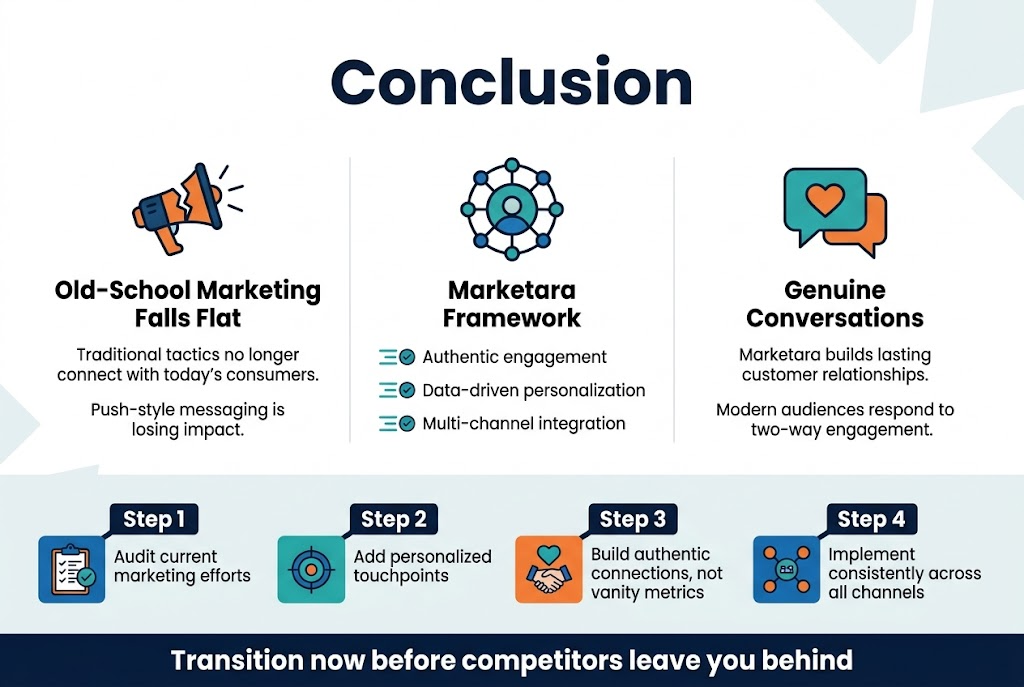
Traditional marketing tactics that worked just a few years ago are now falling flat with today’s consumers. The Marketara strategy framework offers a fresh approach that speaks to modern audiences through authentic engagement, data-driven personalization, and multi-channel integration. Unlike old-school marketing that pushes messages at people, Marketara creates genuine conversations that build lasting relationships with your customers.
The shift to Marketara isn’t just about staying trendy – it’s about survival in an increasingly competitive marketplace. Start by auditing your current marketing efforts and identifying where you can add more personalized touchpoints. Focus on building authentic connections rather than chasing vanity metrics, and remember that success with Marketara comes from consistent implementation across all channels. Your brand’s future depends on making this transition now, before your competitors leave you behind.